

- Academia
- PhD
The Five Rings of a PhD
To know ten thousand things, know one well
15 October 2026, last modified 6 November 2026
When I was in Taiwan, I learned of The Book of Five Rings, a treatise by Miyamoto Musashi organised into five scrolls, one for each of the five elements of Japanese Buddhist cosmology: Earth, Water, Fire, Wind, and Void. Each scroll covers one aspect of strategy a good martial artist should master. And I thought to myself: "why not do the same with a PhD?"
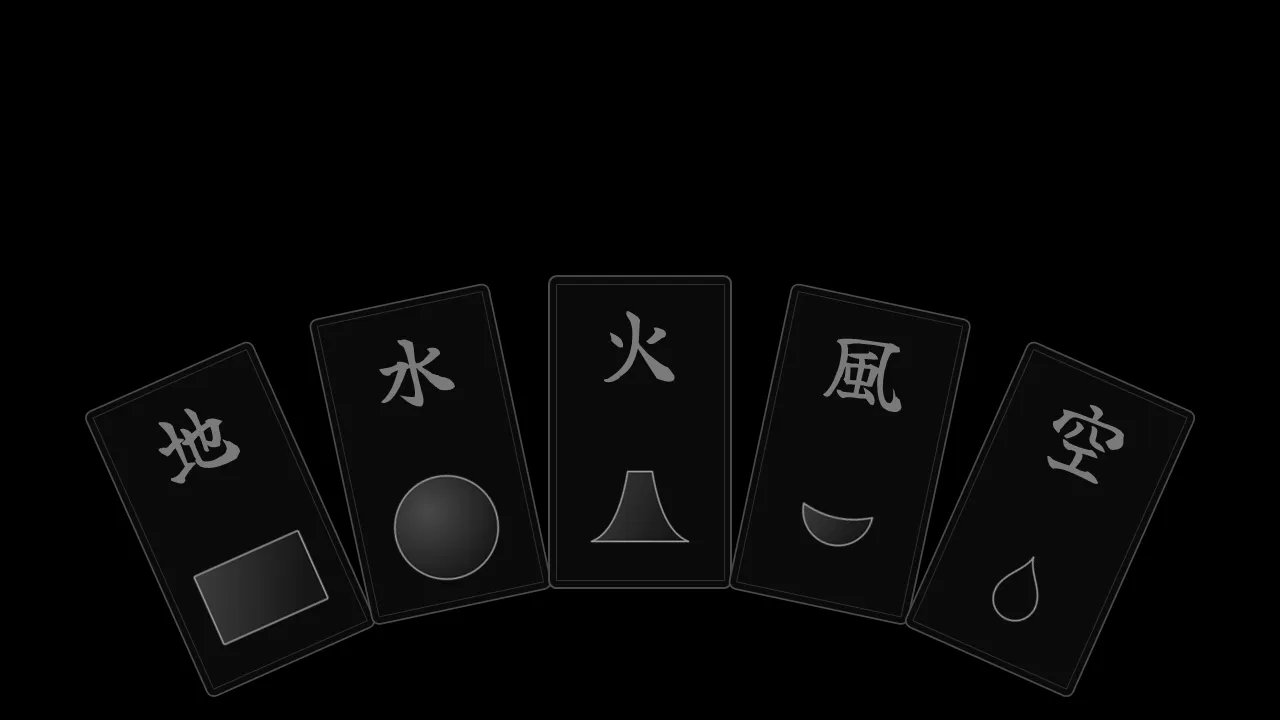
I. Earth
You must know the small through the large and reach the deep by way of the shallow, levelling out the ground for a straight road.
Earth is the scroll of the ground, the foundation on which everything else rests. Musashi compares the strategist to a carpenter, who must understand the whole structure and not only the piece in his hands. Unsurprisingly, this can be immediately translated into the world of research; we are quite familiar with going from the small to the big, from the theory to the methods and vice versa.
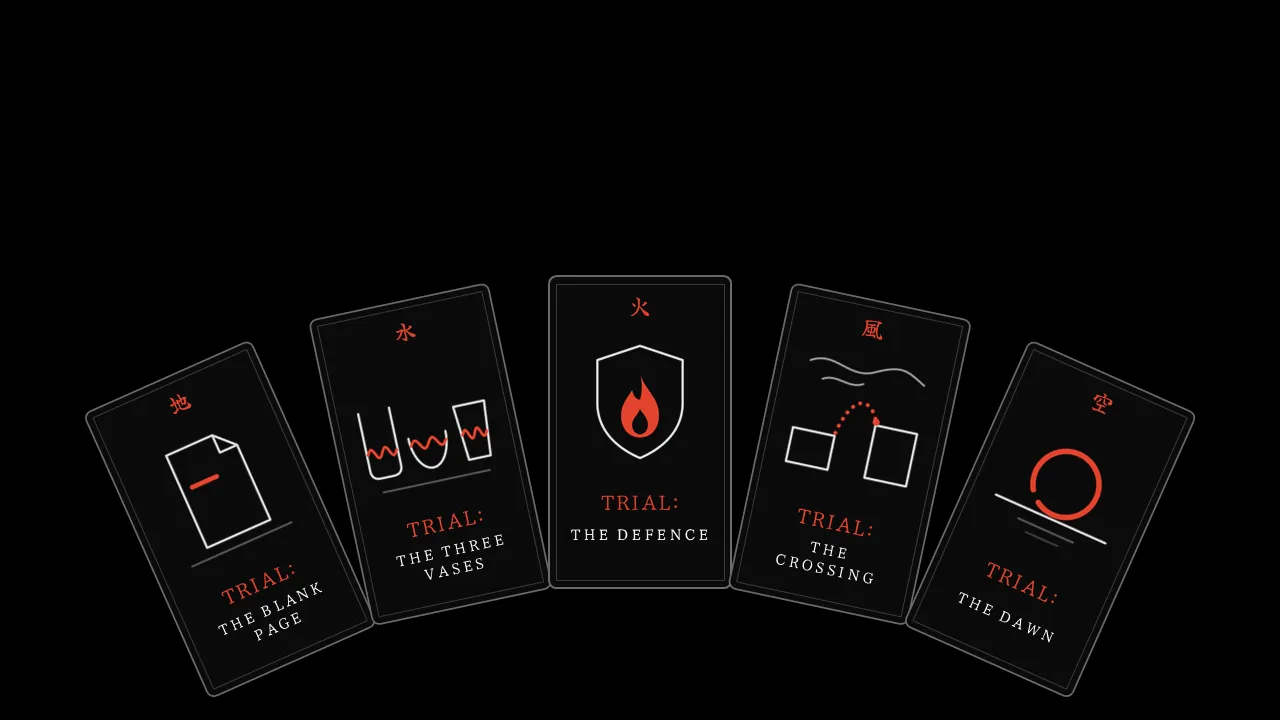
The Trial of Earth: The Blank Page
With only a blank page (or whiteboard!), you should be able to explain a founding result of your field: why it holds, when it fails, why it fails.
II. Water
Fixedness is bad. Work this out well.
Water is the scroll of technique and of the mind that carries it out. Water is always flowing, never stays still, assumes the shape of its vessel, and can be a drop or an ocean. This resembles public speaking and teaching. The concept stays the same, but its form changes with whoever receives it.
The Trial of Water: The Three Vessels
Successfully present the same concept to three different audiences, with three different backgrounds (for example: specialists, students, and people outside the field). This is not straightforward, as each audience has its own sensibility, background, and way of reasoning.
III. Fire
Fire is the heat of battle, your weapons drawn against your opponent. You must choose the ground, seize the initiative, adapt. The doctoral counterpart is immediate.
The Trial of Fire: The Defence
Present and defend your thesis. You will be alone, against an army of professors. Good luck.
IV. Wind
In Japanese, wind is wordplay, as it can also mean "style". The scroll of wind argues that without knowing other schools we cannot truly understand our own. In academia, this is knowing the neighbouring fields well enough to carry our work into them: their questions, their language, and so on.
The Trial of Wind: The Crossing
The trial is the crossing of knowledge. You should be able to read and write articles in a field which is not your own, but close enough that you can recognise its foundations. One has to conform to the structure, ideas, and jargon of nearby fields.
V. Void
Knowing what is there, you know what is not there, and that is emptiness.
Void is the shortest scroll, and it contains no technique. It describes a mind free of confusion. This is the hardest to translate into academia. Luckily, it represents the most daunting side of a doctorate.
The Trial of Void: The Dawn
During a PhD, you are given (to some extent) tools, goals, deadlines. Once a milestone is overcome, others take its place almost naturally. However, after years of this routine, you will be left stranded, possibly without a purpose. The trial of the Dawn is the following question: "and now what?". This is heavily subjective. Overcoming it is easy for some, close to annihilating for others.
Conclusion
Four of the trials come with the doctorate. The fifth, my dear reader, I fear is entirely up to you. Is it possible to fail it? Is it possible to succeed? It is no accident that Musashi ends his book on emptiness. After the techniques, what remains is the mind that chooses.
Here are some slides I used to present this for a course in public speaking. All images come from here. Good luck!